

09.04.2026
Agentic AI vs. AI Agent: What’s the Difference and How Should Enterprises Position It?
Since 2024, two terms have been dominating every tech boardroom: "AI Agent" and "Agentic AI." Both rank among the most frequently heard buzzwords in the artificial intelligence world. But are they the same thing? Absolutely not. And failing to understand this distinction is causing enterprise companies to fundamentally misalign their AI investments.
Navigation
What is an AI Agent?
An AI Agent is an autonomous software unit that interacts with its environment to achieve a specific goal. In the classic sense:
A recommendation engine
A bot that automates a specific process
“…all of these are AI Agents. AI Agents are systems that act when triggered by an input and operate within defined goals, rules, or constraints. Depending on their design, they may work on a single task or coordinate multiple tools and actions to complete more complex workflows.
Think of it this way: The “You might also like” section on an e-commerce site is an AI Agent. It analyzes products and makes suggestions. But if you ask it to “lower this product’s price, update inventory, and analyze competitor pricing”, it stops cold. That’s beyond its capacity.
What is Agentic AI?
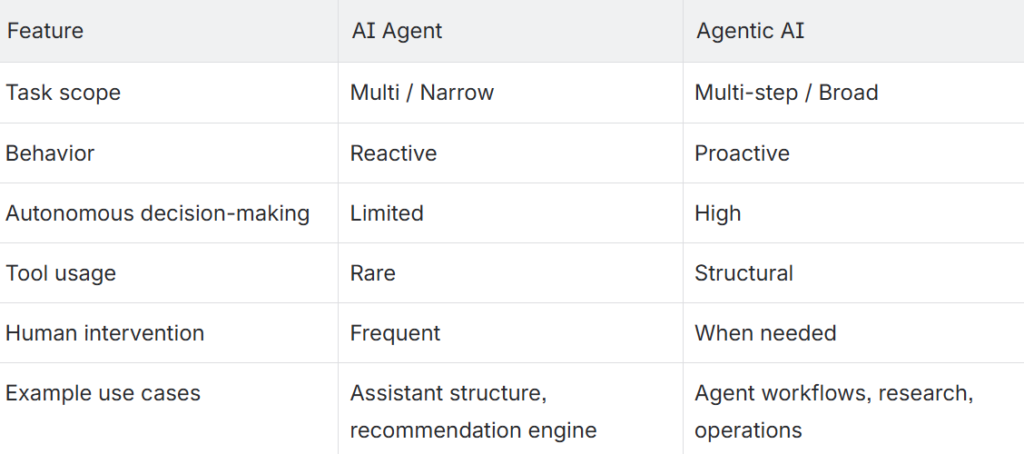
Agentic AI is an entirely different paradigm. Here, “agentic” describes the AI’s capacity for agency to the ability to make autonomous decisions, plan, and execute multi-step tasks with minimal human intervention.
Agentic AI:
Breaks down complex goals into sub-tasks independently
Can use tools, APIs, and external systems dynamically
Makes and updates long-term plans based on evolving context
Acts proactively doesn’t just respond, takes initiative
Minimizes human intervention (but loops humans in when needed)
For example: “Prepare the Q2 campaign report, conduct a competitive analysis, create social media content, and send the team an email.” A system capable of orchestrating all of this autonomously is Agentic AI.
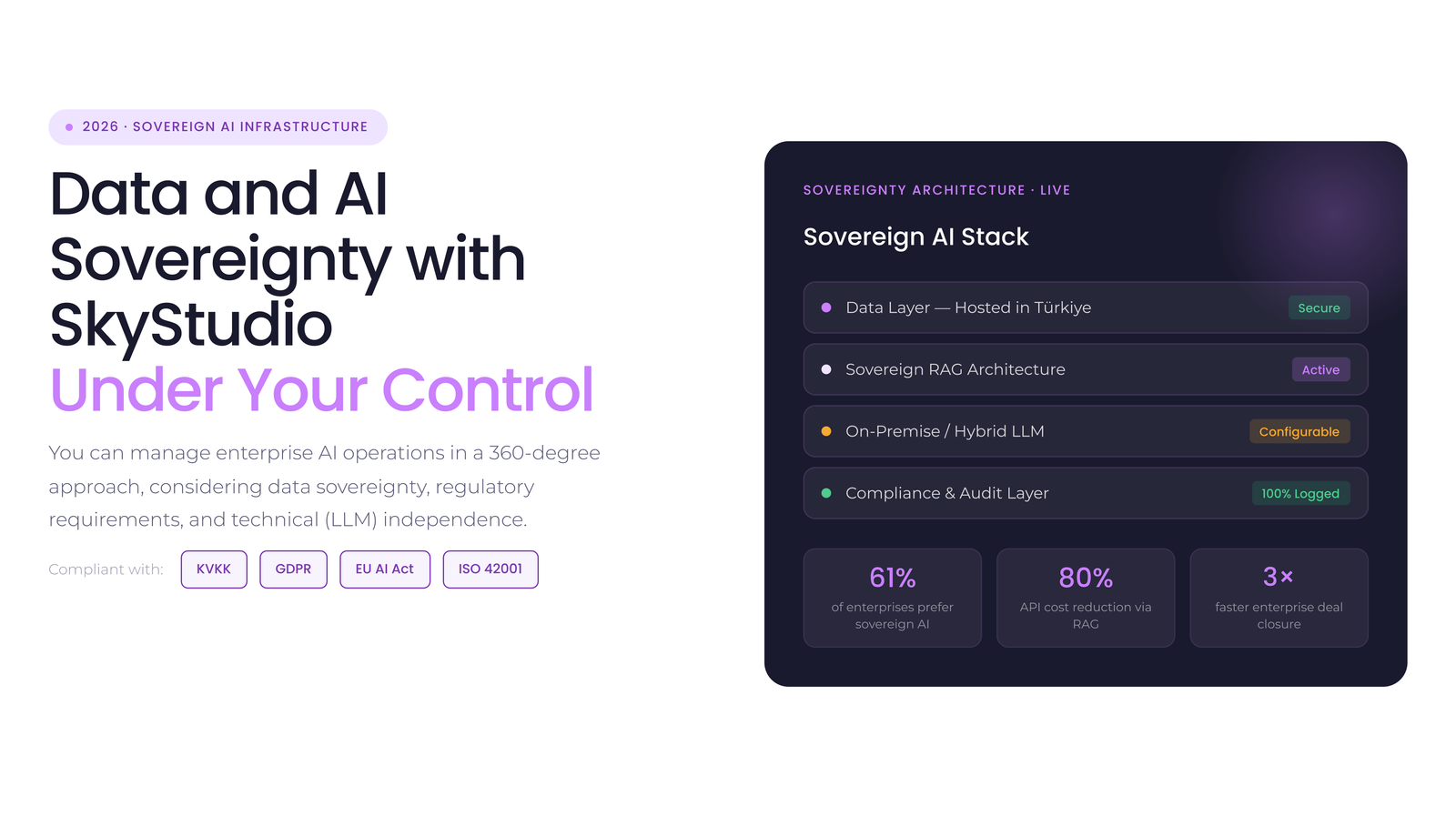
SKYMOD’s SkyStudio platform is built precisely for this: combining multiple agentic capabilities to automate enterprise workflows end-to-end.
The Core Difference at a Glance
How Should Enterprise Companies Position This Distinction?
As a CFO or CTO, you’re asking: “Okay, I understand the difference. But why does it matter to us?” It matters enormously.
1. Investment Prioritization
AI Agents typically operate at the tactical level: they speed up a specific process, lighten a team’s workload. These are low-risk investments with quickly measurable ROI.
Agentic AI, on the other hand, delivers strategic-level transformation: it connects departments, breaks down data silos, and creates durable competitive advantage. However, governance, security, and integration costs are proportionally higher.
2. Governance and Risk
Simple oversight mechanisms suffice for AI Agents. For Agentic AI, however, the following are mission-critical at the enterprise level:
Output validation mechanisms
Human-in-the-loop checkpoints
Granular data access authorization
Comprehensive audit trails
3. Organizational Readiness
Not every company is ready for Agentic AI. If your data infrastructure is lacking, your processes aren’t documented, or AI literacy is low to start with AI Agents. Build the foundation for Agentic AI first.
At SKYMOD, our consulting engagements always begin with an “AI maturity assessment.” Because the wrong tool applied to the right problem is still a costly mistake.
4. Communication and Culture
Telling your employees “you’ll be using AI agents” versus “we’re deploying an Agentic AI system” generates vastly different responses. The first is concrete and understandable; the second can feel abstract and threatening. This distinction in corporate communication is not cosmetic, it’s strategic.
SKYMOD’s Framework
At SKYMOD, we structure this dual approach as follows:
AI Agents → Speed: Automate repetitive tasks, routine reporting, and customer interactions.
Agentic AI → Transformation: With SkyStudio, delegate complex workflows, multi-step research, and operational decision-making to autonomous systems.
Deploying both in concert gives enterprise companies short-term efficiency gains and long-term competitive differentiation simultaneously.
At SKYMOD, we both partner with companies on their AI transformations and support the transformation of the ecosystem with our SkyStudio platform, accelerating companies’ adaptation processes. We don’t just sell products to companies; we teach them how to position AI.
The AI ecosystem is maturing at an unprecedented pace. Simply saying “we use AI” is no longer sufficient. Which AI, for what purpose, and at what level of maturity is the answers to these questions are what separate market leaders from the rest.
Companies that understand the difference between Agentic AI and AI Agents position technology not just as a tool, but as a strategic asset.
At SKYMOD, we’re with you on this journey. If you’d like to explore SkyStudio or conduct an AI maturity assessment for your organization, let’s talk.
Learn More
Request a demo now for AI employees like you.
Contact us to access your free demo.